How Long to Prepare for FIDE: A Realistic Timeline by Starting Level
Realistic preparation timelines for the FIDE German exam by starting level — from 2–3 weeks for confident speakers to 2–3 months from zero. What "30 minutes a day" actually buys you, and what to skip.
Quick summary
Preparation time for the FIDE German test depends on your starting level. Complete beginners need 2–3 months of daily practice (30–60 minutes/day). Basic German from living here: 4–6 weeks of focused preparation. Already using German regularly: 2–3 weeks of exam-specific practice. The most effective approach combines daily listening immersion, speaking practice with real FIDE scenarios, and targeted vocabulary for the 11 official FIDE topics. Consistency beats intensity — 30 minutes every day produces better results than 3-hour weekend sessions.
New here? Start with the complete FIDE exam guide for the full picture of what the test is.
"I have my permit renewal in three months and I barely speak German. Is it even possible?"
I get some version of this question almost every week. The honest answer: yes, it's possible. My husband did it in about 8 weeks — going from extremely basic German to passing FIDE A2. He worked full time the entire period. He'd never successfully learned a foreign language in his life. He was convinced he couldn't do it right up until the day he got his results.
But I'm not going to pretend it was easy, or that everyone's timeline will look the same. How long you need depends on where you're starting, how much time you can give it each day, and whether you're preparing the smart way or the hard way.
Quick answer by starting level
You speak no German at all: 2–3 months with 30–60 minutes of daily practice.
You know basic phrases and understand some German from living here: 4–6 weeks of focused preparation.
You already use German at work or socially but have never taken a formal exam: 2–3 weeks of exam-specific practice.
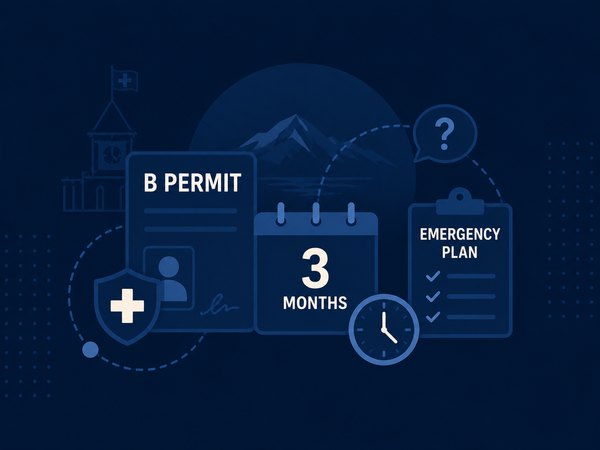
These timelines assume you're preparing for A2 oral (the most common requirement for B and C permits) and studying consistently every day — not just on weekends. If your B-permit deadline is breathing down your neck, the emergency plan walks through the tight version.
What actually determines your timeline
Your starting level
This is the biggest factor by far. Someone who already orders coffee in German, understands train announcements, and chats with their children's teacher has a massive head start over someone who arrives in Switzerland speaking only English.
Be honest with yourself. Rough benchmarks:
True beginner: Fewer than 50 German words. Cannot form a basic sentence. Little or no exposure. You need the full 2–3 months.
Passive knowledge: You've lived in Switzerland for a while. You understand more than you can say. You recognise common words but struggle to produce them. You need 6–8 weeks.
Functional basics: You handle simple daily interactions — ordering food, greeting neighbours, understanding simple letters with some help. You need 4–6 weeks.
Conversational but untested: You speak German at work or with friends but have never taken a test. You need 2–3 weeks of exam-specific preparation.
Your available study time
A realistic daily commitment matters more than heroic weekend marathons. Language learning depends on your brain encountering German repeatedly in small doses. Listening to 20 minutes of German every day for a month rewires your brain in ways a single 10-hour day never will.
30 minutes per day: The minimum for real progress. Enough if you're strategic — prioritise listening and speaking over grammar exercises.
60 minutes per day: The sweet spot for most working professionals. Split it: 20 minutes listening (commute, cooking, walking), 20 minutes vocabulary and reading, 20 minutes speaking practice.
2+ hours per day: You can compress timelines significantly. Use the extra time for additional speaking practice and longer listening sessions. Don't burn out — consistency over weeks matters more than intensity on any single day.
Your learning environment
Living in German-speaking Switzerland is a huge advantage that many people don't fully use. Every interaction at a shop, every announcement on the tram, every letter from your Gemeinde is free German practice.
Living in a German-speaking area and interacting in German daily: Your passive exposure accelerates everything. Less formal study time needed because your brain is already processing German in the background.
Living in a German-speaking area but functioning in English: Very common — international company, expat social circle, English everywhere. You have the environment but aren't tapping it. Switching some daily interactions to German (even small ones) speeds up preparation dramatically.
Not yet in Switzerland: Compensate with more listening and media exposure. German podcasts, YouTube channels, and apps become essential.
Preparation plans by starting level
For complete beginners: the 12-week plan
Starting from zero or near-zero. Goal: A2 oral. Tight but doable.
Weeks 1–4 — build your foundation. Heavy on input. Daily: 15–20 minutes of beginner German content (Easy German on YouTube, Deutsche Welle's Nicos Weg). 10–15 minutes of vocabulary flashcards focused on the most common FIDE words. One short dialogue read out loud. By week 4 you should be able to introduce yourself, say where you live, and recognise common words.
Weeks 5–8 — build confidence. Continue daily listening, increase to 20–30 minutes, switch to slightly harder content (Slow German podcast, SRF Easy News). Start speaking practice — 2–3 sessions per week with an italki tutor (CHF 15–30/hr) focused entirely on conversation and FIDE scenarios. By week 8 you should handle simple conversation about everyday topics, even if grammar is rough.
Weeks 9–12 — exam focus. Drill the specific FIDE format. Practise picture descriptions using a 4-step formula daily. Role-play phone calls. Review all 11 topics, focusing on the 10–15 most important words per topic. Run at least two full mock exams under realistic conditions. Final two weeks: reduce new learning, consolidate.
For basic German speakers: the 6-week plan
You already have some German from living in Switzerland. You understand more than you speak. You need to activate what's already in your head and learn the exam format.
Weeks 1–2 — immersion boost + format familiarisation. Increase daily input significantly. Switch your phone language to German. Listen to German podcasts 30 min/day. One Easy German video per day. Read through the FIDE format. Download the official Modelltest from fide-service.ch. One picture description per day.
Weeks 3–4 — active speaking. The core phase. 2–3 speaking sessions per week with a tutor. Practise all three FIDE speaking tasks. Focus on weakest topics. Learn time-buying phrases for when you get stuck.
Weeks 5–6 — mock exams and polish. 3–4 complete mock speaking tests, timed. Review vocabulary gaps. Fine-tune your personal introduction.
For regular German users: the 3-week plan
You already speak functionally. You just need to know the FIDE format.
Week 1: Study the format. 2–3 picture descriptions. 2–3 phone-call role-plays. Vocabulary review for any FIDE topics you rarely encounter (Behörden, Versicherungen).
Week 2: Full mock exam. Identify weak spots. Practise those areas. Focus on slightly more formal patterns (FIDE is a touch more formal than casual Swiss conversation).
Week 3: Two more mock exams. Fine-tune. Stay relaxed.
The one thing that matters more than anything else
If I had to give only one piece of preparation advice, it would be this: listen to German every single day.
I keep repeating it because it's genuinely the highest-impact activity for speaking ability — and it's the one most people skip because it doesn't feel like "real studying."
Your brain cannot produce language patterns it has never absorbed. When you listen to German — even passively, even when you don't understand everything — your brain builds an internal model of how the language works. Sounds, rhythm, word order, common phrases. All absorbed unconsciously.
Then, when you try to speak, your brain has raw material to work with. Words come more easily. Phrases feel more natural. Pronunciation improves automatically.
Replace some of your English media with German equivalents. Listen to a German podcast on your commute. Watch one German YouTube video while eating lunch. Play German radio while cooking. These small changes compound into massive results over weeks.
Common mistakes that waste your time
Spending too much time on grammar. Grammar is useful, but FIDE doesn't test grammar knowledge — it tests communication. A sentence with a grammar mistake the examiner understands scores better than silence while you construct a perfect sentence in your head. Aim for "good enough" grammar, not perfect grammar.
Using materials designed for Germany. Most German textbooks use vocabulary and situations from Germany. FIDE is specifically Swiss. Learning Fahrrad instead of Velo, or Urlaub instead of Ferien, won't help you. Use Swiss-specific materials.
Not speaking enough. Reading and grammar exercises feel productive, but if you're preparing for a speaking test, you need to spend at least 50% of your time actually speaking. Many people arrive at the exam having barely spoken German out loud and wonder why they freeze.
Trying to learn everything. You don't need 5,000 German words. For FIDE A2 you need roughly 500–800 well-chosen words covering the 11 topics.
Studying only on weekends. A 3-hour Sunday session feels productive in the moment, but your brain forgets most of it by Tuesday. Thirty minutes every day — including weekdays — is dramatically more effective.
Frequently asked questions
My permit deadline is in 6 weeks and I speak almost no German. What do I do?
Focus 100% on speaking and listening — skip grammar study entirely. Learn the top 10–15 words for each of the 11 FIDE topics. Practise describing pictures and role-playing phone calls every day. Get a tutor for at least 2 sessions per week. Consider taking only the oral part (CHF 170) — many permits only require oral proof. It will be tight, but people have done it. Full emergency plan here.
Is 30 minutes a day really enough?
For someone with basic German, yes — if those 30 minutes are focused on speaking and listening, not grammar worksheets. For a complete beginner, 30 minutes is the minimum. More is better, but 30 consistent minutes beats 2 sporadic hours.
Should I take a course or prepare on my own?
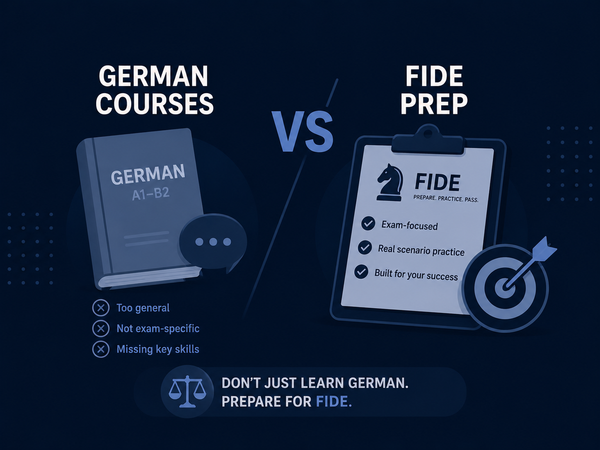
For FIDE specifically, self-study with a tutor or speaking partner is often more effective than a group course. In a group course, you get maybe 3–5 minutes of actual speaking per hour. With a tutor, every minute is active practice. If budget is tight, self-study with free resources plus an AI chatbot for speaking can get you there. More on courses vs targeted prep.
Can I prepare for oral and written together?
Yes, but if time is limited, prioritise oral. Many cantons only require oral proof for permits, and the oral test is where your daily listening and speaking practice pays off directly. You can always take the written part separately later.
What if I fail? How quickly can I retake?
You can retake the FIDE test on the next available date — at centres offering weekly tests, that could be a week later. You only retake the part you failed (oral or written), so you don't lose your passing score on the other part.
Related reading
- The complete FIDE exam guide
- B-permit emergency plan when your deadline is in 6 weeks
- FIDE vs Goethe — which German exam should you take?
- The FIDE picture description formula — speak confidently in 4 steps
- The 11 FIDE speaking topics — complete guide
Start your preparation today
Whether you have three months or three weeks, the key is starting now and being consistent. The book FIDE German A1/A2 Exam Prep gives you a structured 90-day plan, essential vocabulary for all 11 FIDE topics, real dialogue scripts, and a picture description formula — everything you need in one place. Available as PDF on fide-prep.ch or as Kindle on Amazon.
Or sign up to the Sunday list and we'll send you the first chapter as a free PDF. Get the free chapter →