B Permit Renewal in 3 Months and No German? Emergency Plan
Three months and a B-permit deadline: a focused week-by-week plan to go from zero German to a FIDE A1 pass — what to study first, what to skip, and what to do if time runs out.
TL;DR
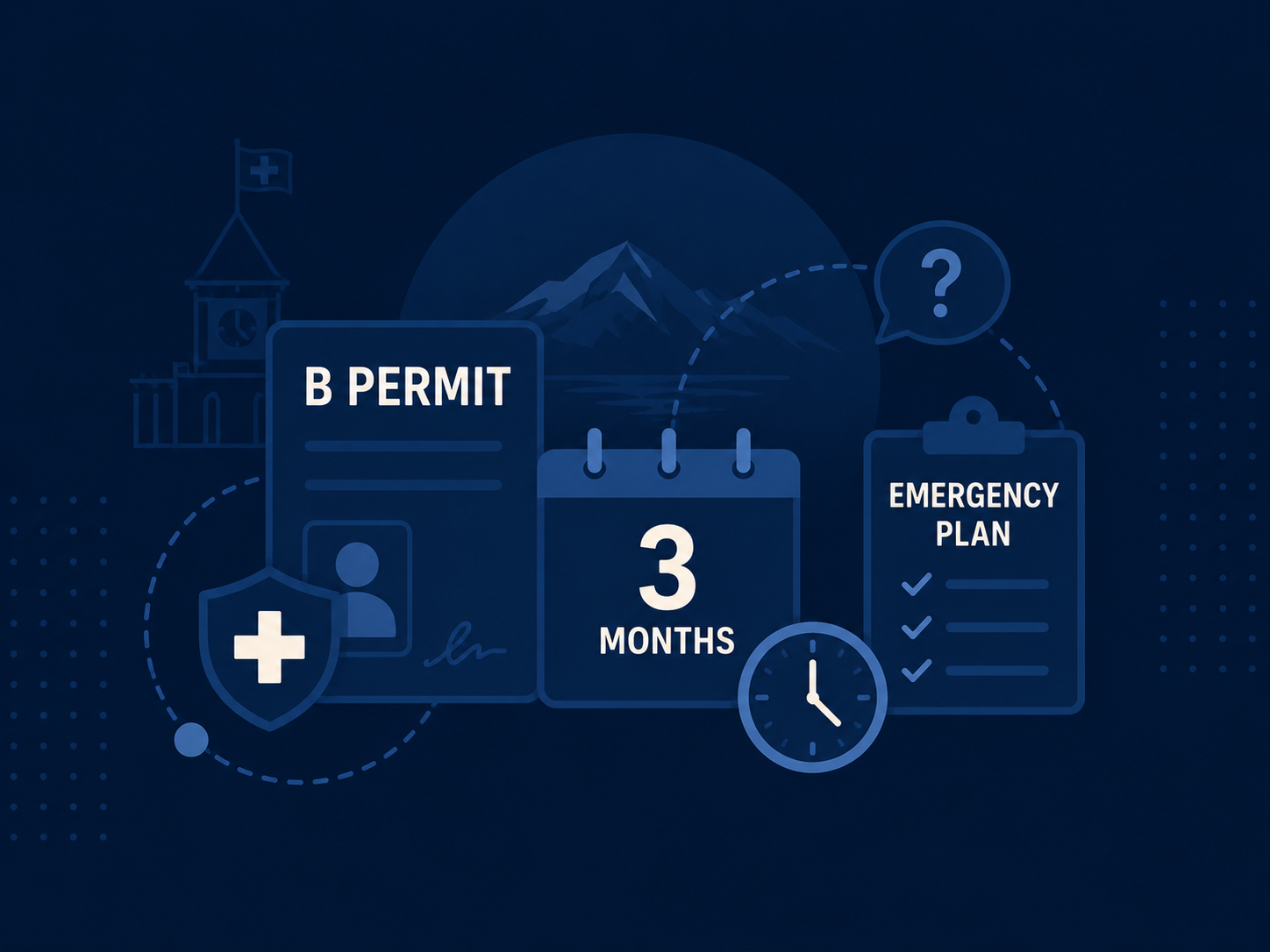
If your B permit renewal is coming up and you have little or no German, don't panic. Non-EU nationals in German-speaking Switzerland typically need at least A1 German for B permit renewal. The FIDE test is the fastest and most practical exam to prove this. With a focused 90-day plan, even complete beginners can reach A1. This article gives you a week-by-week emergency plan, explains exactly what's required, and shows you the fastest path to your language certificate.
You just got the letter from the Migrationsamt. Your B permit is up for renewal in three months, and somewhere in the fine print it says you need to show proof of German skills.
Your stomach drops.
You've been living in Switzerland for a while now. You get by. You smile at the Migros cashier, you nod at your neighbours, and your colleagues helpfully switch to English every time you try a German sentence. But an actual German exam? That feels like a completely different thing.
I get it. When my husband — a native English speaker from the UK — found himself in exactly this situation, he was convinced it was impossible. He'd never seriously studied a foreign language in his life. Growing up speaking English, he never had to.
I'm the opposite. I love languages. I've passed exams in English, German, and French. So when I saw my husband staring at a German textbook like it was written in hieroglyphics, I realised something important: most people don't struggle with German because they're bad at languages. They struggle because nobody showed them where to start.
If you're sitting there with a permit deadline and zero German, here's your emergency plan.
First: do you actually need a German certificate?
Not everyone does. The rules depend on your nationality and your canton.
Non-EU nationals (US, UK, India, Brazil, etc.) are the ones most likely to need a language certificate for B permit renewal. Since 2019, Swiss law requires B permit holders to demonstrate language skills in the language of their canton — German in German-speaking Switzerland.
The typical requirement for B permit renewal is A1 oral. Some cantons may ask for A2. Either way, these are basic levels. You don't need to discuss philosophy. You need to show you can handle simple everyday situations.
EU/EFTA nationals generally don't need a language certificate for the B permit. You will need one later — for the C permit (permanent residence) or for citizenship. So even if you don't need it now, preparing early is smart.
Important: rules vary by canton. Always check with your local Migrationsamt or Gemeinde to confirm what they require. Don't rely on what your friend in another canton needed.
Why the FIDE test is your best option
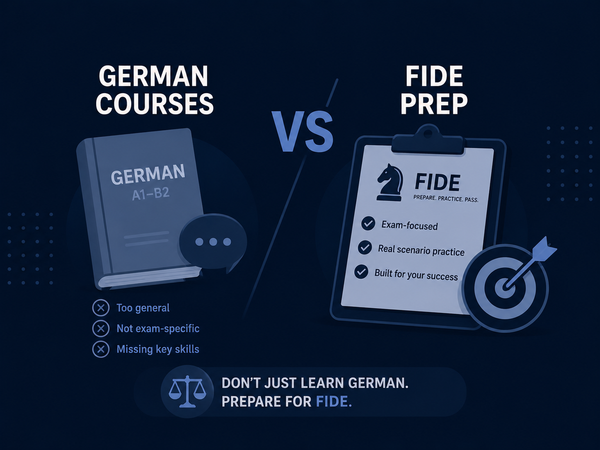
You have several recognised exam options for proving your German: Goethe, telc, ÖSD, or FIDE. Full comparison here.
For people in your situation, FIDE wins on every dimension that matters when time is short:
It's designed for life in Switzerland. FIDE doesn't ask you about abstract topics or textbook scenarios from Germany. It tests whether you can handle real Swiss situations — going to the doctor, talking to your landlord, registering at the Gemeinde, buying a train ticket. If you've been living in Switzerland for any amount of time, many of these situations are already familiar to you.
It's the easiest of the recognised exams. The topics are specific, practical, and limited to 11 modules. You know exactly what to prepare for.
It's flexible. You can take just the oral part (CHF 170), just the written part (CHF 120), or the full test (CHF 250). If your canton only requires proof of spoken German, you save money and time by focusing on speaking only.
Registration is fast. Some Zurich and Bern centres run FIDE tests twice a week. Book at least 15 days ahead. Results arrive within 4 weeks.
Your 90-day emergency plan
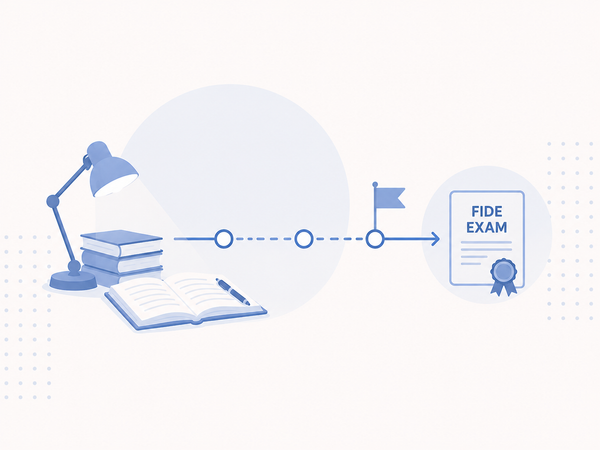
Three months is enough time to go from zero German to passing the FIDE test at A1, sometimes A2. Here's how to structure it. (For a more general timeline framing, see how long to prepare for FIDE.)
Weeks 1–4: build your foundation
The goal of the first month is to get your ears and brain used to German, and to learn the most essential words and phrases.
Daily listening (20–30 minutes). The single most important thing you can do. Listen during your commute, while cooking, while cleaning. Your brain needs to hear the sounds and rhythm of German before it can produce them. Try Easy German on YouTube, the Slow German podcast, or simply switch your phone's language to German.
Learn survival phrases. Don't start with grammar. Start with phrases you actually need: "Ich hätte gerne…" (I would like…), "Können Sie das bitte wiederholen?" (Can you please repeat that?), "Ich verstehe nicht" (I don't understand). These are your emergency tools.
Study one FIDE topic per week. Pick one of the 11 modules — housing, health, shopping, transport, authorities — and learn the 20–30 most important words for it.
Weeks 5–8: start speaking
This is where most people get scared, and it's also where the biggest progress happens.
Practise speaking out loud every day. Even if it's just reading dialogues to yourself. Your mouth needs to get used to forming German sounds. Record yourself on your phone and listen back — you'll be surprised how quickly you improve.
Use a speaking practice tool. Practise common FIDE scenarios: calling to make a doctor's appointment, asking about an apartment, explaining a problem to a shop assistant. The more you rehearse these specific situations, the more automatic they become.
Keep up your daily listening. By now you should start recognising words and phrases in what you hear. This is a great sign — your brain is working even when you don't feel like it is.
Review and expand vocabulary. Continue with flashcards or a vocabulary app. Focus on the FIDE topics you haven't covered yet.
Weeks 9–12: exam preparation
Now it's time to get specific about the exam format.
Practise the exact exam tasks. The FIDE speaking test has a clear structure: describe a picture using a 4-step formula, role-play a phone call, and have a conversation about everyday topics. Practise each task specifically.
Do mock exams. Simulate exam conditions. Set a timer. Have someone ask you questions, or use an AI speaking practice tool. The more familiar the format feels, the less nervous you'll be on exam day.
Master your personal introduction. Every speaking exam starts with you talking about yourself — name, where you're from, what you do, where you live. This should be effortless. Practise it until you could say it in your sleep.
Learn time-buying phrases. Golden during the exam: "Moment bitte" (one moment please), "Wie sagt man…?" (how do you say…?), "Können Sie die Frage bitte wiederholen?" (can you repeat the question please?). They show the examiner you're communicating, even when you're stuck.
Book your exam. Don't wait until the last week. Register for a FIDE test date that gives you at least one week of buffer before your permit deadline, in case results take a bit longer.
What if three months isn't enough?
Sometimes life gets in the way. Work is busy. Kids are sick. You meant to start studying six weeks ago but didn't.
If you're running out of time, prioritise:
Speaking is more valuable than writing for most permit renewals. Check whether your canton accepts the oral-only FIDE test. If yes, focus 100% of your energy on speaking.
Focus on the topics that come up most often. Health, authorities, housing, and transport are the core FIDE modules. If you can handle conversations about these four topics, you're in good shape for A1.
Contact your Migrationsamt. If your deadline is truly impossible, some cantons grant extensions or accept proof that you're enrolled in a language course. Always better to communicate proactively than to miss the deadline silently.
Common mistakes people make under pressure
Spending too much time on grammar. At A1 level, nobody expects perfect grammar. They want to see you can communicate. Get your message across first; grammar polish comes later.
Studying silently. Reading German textbooks without ever opening your mouth will not prepare you for a speaking exam. You need to speak. Every day. Even if it's just to your mirror.
Using materials designed for Germany. Many German textbooks and courses use vocabulary and cultural references from Germany. The FIDE test is Swiss. You should know that a bicycle is commonly called Velo in Switzerland, that Grüezi often replaces Guten Tag, and that the spelling uses ss instead of ß.
Trying to learn everything. You don't need to know everything. You need to know enough to pass A1 or A2 — a finite, manageable amount of material. Stay focused.
You can do this
I know it doesn't feel like it right now. When my husband was in your position, he was absolutely certain he would fail. He's a smart, capable professional who runs complex projects at work — but the idea of speaking German in an exam room made him want to hide.
He passed. Not because he became fluent in three months, but because he studied the right things in the right order, practised speaking every day, and walked into the exam knowing exactly what to expect.
The FIDE test is not designed to trick you. It's designed to check whether you can manage basic daily life in German-speaking Switzerland. With three months of focused preparation, you absolutely can.
Frequently asked questions
Can I get a deadline extension from the Migrationsamt?
Sometimes yes. Contact your cantonal Migrationsamt proactively, explain that you have a confirmed FIDE exam date, and ask about a short extension. Many cantons grant 2–8 week extensions if you show evidence of a booked exam or active language course enrolment. Don't go silent — extensions are much harder to get after a deadline has passed.
A1 or A2 — which should I aim for?
Whatever your permit actually requires. Most B-permit renewals only need A1 oral. Aiming for A1 from zero in 3 months is realistic; aiming for A2 from zero is tight. The FIDE test starts at A2 and steps down to A1 if needed, so even if you only pass A1 you still get an official certificate.
Can I take just the oral part to save time?
Yes. The FIDE oral test on its own costs CHF 170 (vs CHF 250 for the full test) and many B-permit renewals only require oral German. Always confirm with your Migrationsamt or Gemeinde first — some cantons require both oral and written.
Is 3 months really enough from zero German?
For A1 oral, yes — at 30–45 minutes daily of focused, speaking-heavy practice. For A2, it's tight; 4–6 months is more realistic from zero. The biggest predictor of passing is daily consistency, not total weekly hours.
What if I miss the deadline?
Don't ignore the letter. Contact the Migrationsamt as soon as you know you'll be late and explain your situation — most are willing to work with people who communicate. The worst outcome (permit not renewed) usually requires repeated non-response, not a single missed date.
Related reading
- The complete FIDE exam guide
- How long to prepare for FIDE — a realistic timeline
- FIDE vs Goethe — which German exam should you take?
- The FIDE picture description formula — speak confidently in 4 steps
Ready to start preparing?
The book FIDE German A1/A2 Exam Prep gives you everything you need: all 11 FIDE topics with vocabulary and dialogues, emergency phrases, a 90-day study plan, and practice scenarios you'll actually face in the test.
Available as PDF on fide-prep.ch or as Kindle on Amazon.
Or sign up to the Sunday list and we'll send you the first chapter as a free PDF. Get the free chapter →