German Courses vs FIDE Prep: When Generic German Doesn't Cut It
Generic German courses are great for general fluency. They are not always great for the FIDE exam, which tests very specific scenarios in a fixed format. Here's why traditional classes can fail FIDE candidates — and what to do alongside (or instead).
Quick summary
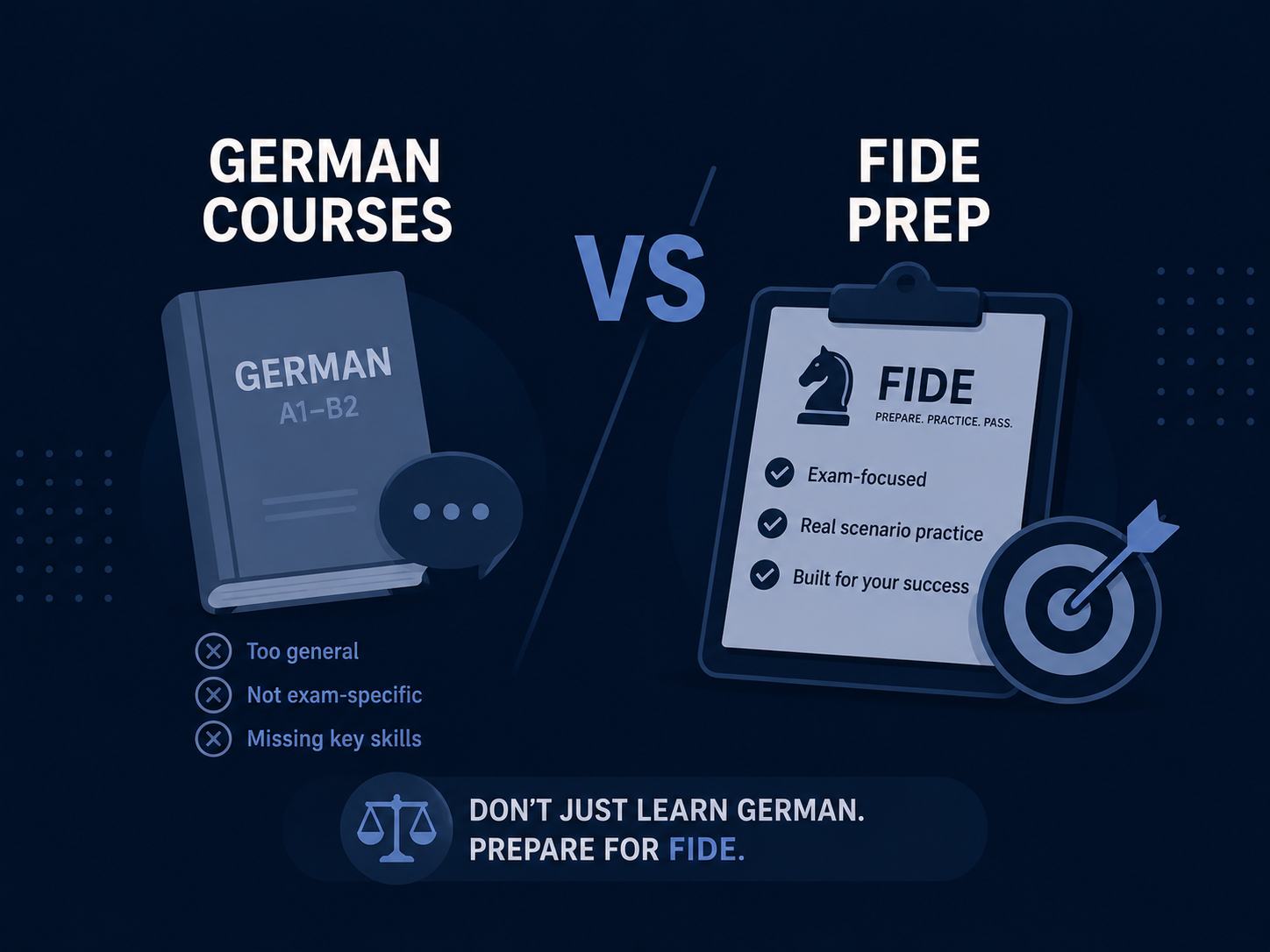
Traditional German courses are great for building general fluency. They're not always efficient for the FIDE exam, which tests very specific Swiss everyday scenarios in a fixed format. The biggest gaps: not enough speaking time per student, generic curriculum that doesn't follow the 11 FIDE topics, German-from-Germany vocabulary, rigid pacing. The most effective alternative — or supplement — is targeted, speaking-heavy practice: a 1-on-1 tutor focused on FIDE scenarios, plus daily self-study around the actual exam format.
Most expats in German-speaking Switzerland default to the same plan: sign up for a German course. The Migros Klubschule two evenings a week, or the local Volkshochschule, or whatever the company subsidises. Then, somewhere along the way, the FIDE exam comes up.
Here's the uncomfortable truth: a generic German course can absolutely build your German over time. What it often can't do is prepare you for the FIDE exam efficiently. The exam is too specific, and the course is too general. They are not the same thing.
This article is about why that gap exists, what to do about it, and when a course actually helps versus when it just costs you weeks.
What the FIDE exam actually tests
FIDE is not a general German exam. It's a Swiss-specific test built around 11 fixed topic areas (housing, health, work, authorities, and so on — see the full list with examples) and a fixed format: describe a picture, role-play a phone call, have a conversation. The vocabulary is Swiss (Velo, not Fahrrad; Spital, not Krankenhaus; Ferien, not Urlaub). The scoring rewards communication, not academic correctness.
Knowing what FIDE tests is half the work. The other half is practising those exact things, ideally with a German-speaker giving you live feedback.
The four problems with traditional courses for FIDE
1. Not enough speaking time per student
The single biggest issue. In a typical class of 10–12 students with a single teacher and a 60-minute lesson, the maths are brutal: maybe 3–5 minutes of actual speaking time per student per hour. The rest is listening to the teacher, watching others struggle, or doing silent exercises.
FIDE is fundamentally a speaking exam. The speaking part is two-thirds of your oral score. If you spend 80% of your prep time not actually speaking, you're under-training the most important muscle.
2. Generic curriculum, not FIDE-specific
Most German textbooks were written for someone learning German in Cologne or Munich, not for someone preparing to talk to a Migrationsamt in Zurich. They cover present tense before past tense, then dative, then comparatives, then subordinate clauses — a logical sequence for general German.
FIDE doesn't care about logical grammatical sequencing. It cares whether you can call your Hausarzt, write to your neighbour, and describe a picture of a queue at the post office. That's a different curriculum.
3. German-from-Germany vocabulary
Most courses teach standard German with Germany-flavoured vocabulary and cultural references. Hauptbahnhof in Berlin, the Bürgeramt, the Krankenhaus. None of these are exactly wrong — but they're not what the FIDE test (or your daily life in Switzerland) uses.
You need to know SBB, Gemeinde, Spital, Velo, Billett, Krankenkasse, Franchise (Swiss insurance term, not the English business one), RAV, AHV. Specifically Swiss vocabulary appears across the whole exam — and a generic course typically doesn't drill it.
4. One pace for everyone
A class moves at the speed of the median student. If you're a fast learner with prior language experience, you're bored half the time. If you're juggling a full-time job and a family and you missed the lesson on perfect tense, the next lesson assumes you got it — and you fall behind without knowing it.
FIDE prep needs to spend disproportionate time on your specific weak spots. A class can't do that for 11 students at once.
What works instead
The single most cost-effective FIDE prep, for most working professionals, is some version of this:
1. A 1-on-1 tutor on italki, focused on FIDE scenarios. Tutors there charge roughly CHF 15–30 per hour. Tell them upfront: "I'm preparing for the FIDE exam. I want to spend our sessions on picture descriptions, role-played phone calls, and conversation about the 11 topics." Two sessions per week of 30–45 minutes is enough.
2. Daily self-study around the exact exam format. Twenty to thirty minutes a day. The first two weeks: vocabulary for the 11 topics. Weeks 3–6: picture descriptions and rehearsed phone calls (alone, out loud, recording yourself). Weeks 7+: mock exams.
3. Daily listening immersion. Free, the highest-impact thing you can do, and the one most people skip. Easy German on YouTube, Deutsche Welle's Langsam Gesprochene Nachrichten, the SRF News app. 15–20 minutes a day during your commute.
4. A FIDE-specific book or guide. Something that gives you the 11 topics with vocabulary, dialogues, and the exam format pre-organised. This is what general textbooks don't do.
That's it. No 12-week course required. More on how to spend the time week-by-week.
Rough cost comparison
For 8 weeks of preparation aiming at A2 oral:
Group course route. 8 weeks × 2 evenings × 1.5 hours = 24 hours of class. Typical Swiss Klubschule price: CHF 600–900. Of those 24 hours, you actually speak for maybe 2–3 hours. Cost per hour of speaking practice: ~CHF 250.
Targeted route. 8 weeks × 2 italki sessions × 45 minutes = 12 hours of speaking, all 1-on-1. Tutor cost at CHF 25/hr: ~CHF 300. Add a FIDE-specific book (~CHF 30) and a couple of in-person mock-exam sessions (~CHF 100–200). Total: ~CHF 450–550 for ~15 hours of focused speaking. Cost per hour of speaking practice: ~CHF 30.
The targeted route also gets you Swiss-specific vocabulary and the exact exam format — both of which the group course typically misses.
When a course actually helps
I'm not against group courses on principle. They have a real role at certain points:
True beginner phase. If you literally don't know the alphabet, numbers, present tense, or common nouns, a structured course is the most efficient way to bootstrap. You can't do FIDE-specific work without basic German first. A 6–8 week beginner course gets you to a level where targeted FIDE prep starts to pay off.
Social motivation. Some people study better with classmates and a fixed schedule. If a course is the difference between you actually studying and you not studying, take the course. Then add 2–3 hours per week of FIDE-specific work alongside.
Conversation classes specifically. A class billed as a Konversationskurs (rather than a general course) usually gives more speaking time per student. Worth checking out at the Klubschule Migros.
Workplace pressure. If your company subsidises a course and won't subsidise an italki tutor, the course is free for you. Take it. Just don't assume it alone gets you to FIDE-ready.
Combining both: course + targeted FIDE prep
For most candidates, the strongest setup is to layer FIDE prep on top of an existing course. Roughly:
- Course. 2–3 hours per week. Builds the foundation. Don't expect it to teach FIDE.
- Tutor. 1–2 sessions per week, FIDE-focused. This is where the speaking volume comes from.
- Self-study. 20–30 minutes daily. Vocabulary, picture descriptions, listening.
- Mock exams. One full mock in the last 2 weeks before your exam date.
Total weekly commitment: 5–7 hours. Most people who pass first try are in this range.
Frequently asked questions
Should I drop my current German course?
Probably not — but you may need to supplement it. A general course builds a useful foundation. The gap is FIDE-specific practice: the exam format, the 11 topics, Swiss-specific vocabulary, and large amounts of speaking time. Add 2–3 hours per week of targeted FIDE work alongside your course.
Is a tandem partner enough on its own?
For some learners, yes — if your tandem partner is willing to role-play FIDE scenarios (phone calls, picture descriptions, conversations on the 11 topics) rather than just chat. If they only want casual conversation, you'll need supplementary structure: a textbook, a course module, or focused self-study around the FIDE format.
When does a German course actually help for FIDE?
When you're a true beginner and need basic structure (alphabet, numbers, present tense, common nouns) before you can do anything FIDE-specific. Courses are most efficient at the very start. Once you've reached A1.2 or A2.1, switching to targeted FIDE prep usually pays off more per hour.
How much speaking time do I actually need?
FIDE is a speaking exam. Aim for at least 50% of your prep time spent actually speaking — out loud, with someone or something responding. In a 12-person group course, you typically get 3–5 minutes of personal speaking per hour. With a 1-on-1 tutor, every minute counts. Mathematics says the difference is dramatic over weeks.
What's the cheapest effective combination?
For most learners: an italki tutor at CHF 15–30/hour for 2 sessions per week (focused on FIDE scenarios), plus daily self-study with a FIDE-specific book and free listening resources (Easy German, Deutsche Welle). Total over 8 weeks: roughly CHF 300–500 plus the book — significantly cheaper than most Swiss group courses, with more speaking practice.
Related reading
- The complete FIDE exam guide
- FIDE vs Goethe — which German exam should you take?
- How long to prepare for FIDE — a realistic timeline
- B-permit emergency plan when your deadline is in 6 weeks
- The 11 FIDE speaking topics — complete guide
A self-study toolkit that works
The book FIDE German A1/A2 Exam Prep is built specifically for the targeted route: all 11 FIDE topics with Swiss-specific vocabulary, real dialogue scripts, the picture description formula, and a 90-day plan you can run alongside any course (or instead of one). Available as PDF on fide-prep.ch or as Kindle on Amazon.
Or sign up to the Sunday list and we'll send you the first chapter as a free PDF. Get the free chapter →