FIDE Exam Switzerland: The Complete Guide to Switzerland's German Test
Switzerland's official German exam, built by the State Secretariat for Migration for permits and citizenship. What FIDE tests, what it costs, how to prepare, and how it compares to Goethe and telc — in one guide.
Quick summary
The FIDE test is Switzerland's official German language exam, created by the State Secretariat for Migration (SEM) for residence permits and citizenship. It costs CHF 250 for the full test (oral CHF 170, written CHF 120), takes about 100 minutes in total, and tests practical everyday German at A1–B1. Unlike Goethe or telc, FIDE focuses entirely on real Swiss situations — doctor visits, the Gemeinde, shopping, work. It's widely considered the easiest German exam accepted for Swiss permits. You can register at any accredited test centre across Switzerland; results arrive by post in roughly 4 weeks as an official Language Passport (Sprachenpass).
If your permit renewal is coming up and you still haven't passed a German test, take a breath. You're not the only one in this situation, and you have more options than you think.
When my husband needed to prove his German skills for his B permit, we spent weeks confused about which test to take, where to register, and what the exam actually looked like. Every website seemed to have different information. Some were only in German. Others were outdated. By the time we figured it all out, we'd wasted weeks we could have spent preparing.
This guide is everything I wish we'd found back then. No fluff, no unnecessary detail — just the clear, practical information you need to understand the FIDE test and decide if it's right for you.
What is the FIDE test?
The FIDE test (sometimes written "fide-Test") is Switzerland's own German language exam. It was developed on behalf of the State Secretariat for Migration (SEM) — the same government body that processes your residence permits. That's an important detail, because it means the test was designed from the start to match exactly what Swiss authorities need to see.
Unlike internationally known exams like the Goethe-Zertifikat or telc, the FIDE test doesn't measure your academic German. It measures whether you can handle everyday life in Switzerland. Can you describe your symptoms to a doctor? Can you call your landlord about a broken heater? Can you understand a letter from your Gemeinde? That's what FIDE cares about.
The test covers levels A1 through B1 on the Common European Framework (CEFR). For most permit applications you need A2 speaking and A1 writing — a level that's absolutely achievable within 2–3 months of focused preparation, even if you're starting from scratch.
Who needs the FIDE test?
You likely need a recognised German test if you're applying for any of the following:
B permit (Aufenthaltsbewilligung) renewal. Many cantons now require proof of language skills. The exact requirement depends on your canton and situation, but A1 oral is a common minimum. If your B-permit deadline is in weeks rather than months, read the emergency plan.
C permit (Niederlassungsbewilligung). You typically need A2 oral and A1 written for the settlement permit. The fast-track C permit (after 5 years instead of 10) requires B1 oral.
Swiss citizenship (Einbürgerung). Naturalisation requires at least B1 oral and A2 written in one of the national languages. The FIDE test covers up to B1, so it can serve this purpose too.
Important: requirements vary by canton. Always check with your local Gemeinde or migration office for the exact levels you need. The FIDE Sprachenpass reports your oral and written skills separately — which is helpful because many people speak better than they write, and some permits only require the oral part.
What does the FIDE test look like?
The test has two independent parts. You can take both on the same day, or take them separately — a useful flexibility if you want to focus your preparation.
The oral part: Sprechen und Verstehen (speaking and understanding)
Duration: approximately 40 minutes (your active speaking part is about 15 minutes).
You sit across from one examiner while a second examiner observes and takes notes. There's no computer, no headphones, no multiple choice. It's a face-to-face conversation.
The oral test always starts at the A2 level with three tasks:
- Picture description (Situationsbeschreibung). The examiner shows you a picture of an everyday Swiss situation — someone at a doctor's office, a family in a kitchen, a queue at the post office. You describe what you see. Who is in the picture? What are they doing? Where does this seem to be? There's a 4-step formula for this task that takes the panic out of it.
- Phone call simulation (Telefonat). You role-play a phone call. You might need to call a doctor's office to make an appointment, or a school to say your child is sick. You give information, ask questions, and react to what the examiner says.
- Conversation (Gespräch). The examiner asks about your habits, experiences, or opinions on an everyday topic — your work routine, what you do in your free time, how you commute.
After these A2 tasks, the examiners evaluate your performance and recommend either A1 or B1 for the next phase. They tell you their recommendation and you can accept or choose differently — you confirm your choice with a signature.
If you move to A1: two simpler tasks — naming objects and situations in pictures, and responding to basic everyday interactions (greeting, asking directions).
If you move to B1: a longer conversation where you describe an experience in detail, explain a process, or discuss the pros and cons of a situation.
A strategic tip from personal experience: if you've prepared for A2 and the examiners suggest trying B1, think carefully. Unless you specifically practised B1-level conversations, it's often smarter to go for A1 and secure a solid A2 result rather than risk a lower score on a B1 attempt. You can always retake the test later for B1.
The written part: Lesen und Schreiben (reading and writing)
Duration: approximately 60 minutes (plus a 15-minute introduction where the format is explained).
The written test is divided into modules of increasing difficulty. The A1–A2 test has three modules with six tasks:
- Module 1 (easiest). Read a short text — an invitation or a notice — and transfer specific information into an SMS or message. Fill out a simple form with your personal details.
- Module 2 (medium). Find specific information in a longer text and underline it. Fill out a form and add short written remarks based on prompts.
- Module 3 (A2 level). Compare information across two texts and organise it into a list. Write a short email responding to prompts — for example, replying to a neighbour about a building meeting or writing to a doctor's office to change an appointment.
Scoring. The A1–A2 written test has a maximum of 48 points. You need about 39% (18.5 points) for an A1 result and about 76% (36.5 points) for A2. You don't need to be perfect — you need to show solid practical ability.
How much does the FIDE test cost?
Prices are set nationally and are the same at every accredited test centre:
- Complete test (oral + written): CHF 250
- Oral part only: CHF 170
- Written part only: CHF 120
- Duplicate Language Passport: CHF 35
If you only need proof of oral skills (which is the case for many B-permit renewals), taking just the oral part for CHF 170 saves you both money and stress. You can always add the written part later if needed.
For comparison, a Goethe A2 exam costs around CHF 230, and a B1 around CHF 290; telc is similarly priced. FIDE is either the same or cheaper, and most candidates find it significantly easier because it focuses on practical communication rather than academic German. Full FIDE vs Goethe comparison here.
How to register
- Find an accredited test centre. The official list is on fide-service.ch. Centres exist across all German-speaking cantons; major cities (Zurich, Bern, Basel, Lucerne) offer the most frequent dates.
- Contact the centre directly to register. Some offer online registration.
- Register at least 15 days before your preferred test date. Popular centres fill up.
- Choose: full test, oral only, or written only.
- Bring a valid ID (passport or residence permit) on test day.
Some centres (e.g. ILS Zurich) run FIDE tests twice a week. Others run them monthly. If your timeline is tight, check multiple centres — you might find an earlier date in a neighbouring city.
Cancellation policy: most centres charge a processing fee of around CHF 30 for cancellations made at least 20 days before the test. Cancellations less than 20 days before the test generally aren't refundable.
When will you get your results?
Results arrive by post approximately 4 weeks after the test. For tests taken between mid-December and mid-January, allow up to 6 weeks because of the holiday period.
You receive an official Language Passport (Sprachenpass) that lists your oral and written results separately. This is the document you submit to your canton's migration office.
The test centre and the FIDE office cannot give results by phone — you have to wait for the post.
Planning tip: if you have a specific permit deadline, count backwards. You need 4 weeks for results, plus your preparation time, plus the time to find an available test date. Realistic preparation timelines here.
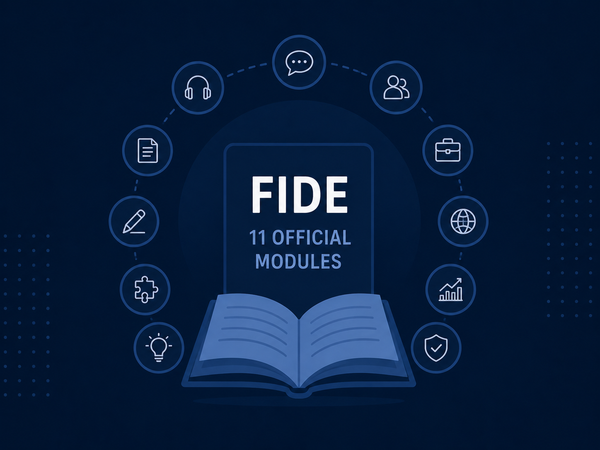
The 11 official FIDE topics
All FIDE test content comes from 11 real-life topic areas — the same whether you take the oral or written test. Knowing these topics is the foundation of your preparation. Each links to articles on the topic:
- Wohnen — Housing & home: talking to landlords, discussing apartments, communicating with neighbours.
- Arbeit — Work & job search: workplace conversations, meetings, requesting time off, RAV registration, interviews.
- Gesundheit — Health & doctor visits: describing symptoms, pharmacy interactions, Krankenkasse questions.
- Einkaufen — Shopping & errands: buying things, returning items, complaints.
- Essen & Trinken — Food & drink: ordering, allergies, restaurant interactions.
- Freizeit — Leisure & hobbies: making plans, discussing hobbies, handling invitations.
- Reisen & Verkehr — Travel & transport: buying tickets, asking for directions, reporting problems on the SBB.
- Kinder & Schule — Children & school: daycare and school registration, parent-teacher meetings, reporting absences.
- Behörden — Authorities & services: Gemeinde visits, permit extensions, post office, bank, insurance.
- Medien — Media & communication: phone calls, emails, formal vs informal register.
- Leben in der Schweiz — Life in Switzerland: cultural questions, integration topics, practical daily life.
If you can handle a basic conversation and read simple texts in each of these areas, you're ready for the FIDE test. You don't need to be perfect — you need to be functional. Each speaking topic in detail, with example dialogues, is here.
How to prepare effectively
Having helped my husband go from practically zero German to passing his FIDE A2 exam in about 8 weeks, here's what I learned works — and what doesn't.
What doesn't work
Grammar-heavy studying. The FIDE test does not ask you to conjugate verbs on paper or identify the dative case. It asks you to communicate. If you spend 80% of your time on grammar exercises, you're preparing for the wrong test.
Generic German textbooks. Most textbooks teach standard German with vocabulary and examples from Germany. They talk about the Hauptbahnhof in Berlin, not the SBB, and about the Bürgeramt, not the Gemeinde. The FIDE test is specifically Swiss, and your preparation should be too.
Group courses alone. In a class of 12 people, you might get 3 minutes of actual speaking time per hour. The FIDE test is fundamentally about speaking. You need to practise speaking far more than a typical course allows.
What works
Focused listening. Counterintuitive but true: the single most effective thing for speaking ability is listening. Your brain needs to hear German patterns hundreds of times before it can produce them. Listen to Easy German on YouTube, try Deutsche Welle's learner podcasts, or follow the SRF News app in simple German. Do this during your commute, while cooking, while cleaning. It doesn't feel like studying, but it's the most powerful thing you can do.
Speaking practice with real scenarios. Practise the actual FIDE scenarios: describe pictures out loud, role-play phone calls, talk about your daily routine. A language partner or tutor on italki (often CHF 15–30 per hour, cheaper than most Swiss courses) for conversation alone is excellent value.
Swiss-specific vocabulary. Learn the words that come up in Swiss daily life: Velo (bicycle), Billett (ticket), Gemeinde (municipality), Krankenkasse (health insurance), Hausarzt (family doctor), Spital (hospital). These are the words FIDE uses.
Exam-format practice. Know what the test looks like. Practise picture description with a simple formula. Practise short emails. The FIDE test has a predictable format, and familiarity with it removes a huge amount of stress on exam day.
For a realistic week-by-week plan, see how long to prepare for FIDE.
FIDE compared to other German exams
If you're trying to decide between FIDE and another exam, here's the short version:
- FIDE vs Goethe. FIDE is shorter (100 minutes vs 3–4 hours), cheaper at lower levels, focused on practical Swiss scenarios. Goethe is more academic and internationally recognised. Choose FIDE if you need a Swiss permit; choose Goethe if you need a certificate for a German university or international employer. Full comparison →
- FIDE vs telc. Both are accepted for Swiss permits. telc is more structured and standardised, with separate modules. FIDE is more conversational and Swiss-specific. Most people preparing for a Swiss permit find FIDE easier.
- FIDE vs ÖSD. The ÖSD (Österreichisches Sprachdiplom) is the Austrian exam. It's accepted in Switzerland but uses Austrian German conventions. FIDE is the more natural choice for Swiss residents.
Bottom line: if your goal is a Swiss residence permit or citizenship, the FIDE test is the most direct path. It was literally designed for this purpose.
Frequently asked questions
What level do I need for my permit?
B permit: A1 written + A1 oral. C permit (standard): A1 written + A2 oral. C permit (fast track, after 5 years): A1 written + B1 oral. Einbürgerung (citizenship): A2 written + B1 oral. Cantons can set higher levels — always check your Migrationsamt letter first.
How is FIDE different from Goethe or telc?
All three test reading, writing, and speaking. FIDE is Swiss-specific and shorter (about 100 minutes vs 3–4 hours for Goethe), and you can take the oral and written parts at different levels. Goethe and telc are general-purpose international exams. For a Swiss permit or citizenship, FIDE is the most direct path; trade-off is that it's only recognised in Switzerland.
Can I take the oral and written parts on different days?
Yes. You can take them separately and even at different test centres. Many people take the oral part first, since that's what most permits require, and add the written part later if needed.
What if I fail?
You can retake the test. You only need to retake the part you failed. If you passed the oral but not the written, you just retake the written part.
Is the FIDE test in Hochdeutsch or Swiss German?
The test is conducted in standard German (Hochdeutsch). You don't need to understand or speak Swiss German dialect. The content and vocabulary are however Swiss-specific — Spital instead of Krankenhaus, Velo instead of Fahrrad, ss instead of ß.
Do I need to take a preparation course?
No. There's no requirement to take a course before the test. Many people prepare independently using books, apps, and online resources. Speaking practice with another person is strongly recommended.
I work full time. How can I prepare?
Thirty minutes of focused daily practice beats a 3-hour weekend session. Listen to German during your commute, drill flashcards at lunch, do 15 minutes of speaking practice in the evening. Consistency matters more than intensity.
My permit deadline is in 3 months and I speak no German. Is it possible?
Tight but possible. A2 oral is achievable in 2–3 months with focused preparation. The key is to prioritise speaking and listening over grammar and writing. Step-by-step emergency plan here.
How long is the Sprachenpass valid?
The FIDE Language Passport doesn't expire. Once you have it, it's valid indefinitely for use with Swiss authorities.
How much does the FIDE test cost?
CHF 250 for the full test. CHF 170 for oral only, CHF 120 for written only. CHF 35 for a duplicate Language Passport. Prices are set nationally and identical at every accredited test centre.
Related reading
- FIDE vs Goethe — which German exam should you take?
- How long to prepare for FIDE — a realistic timeline
- B-permit emergency plan when your deadline is in 6 weeks
- The 11 FIDE speaking topics — complete guide with examples
- The FIDE picture description formula — speak confidently in 4 steps
Ready to pass your FIDE exam without the stress?
The book FIDE German A1/A2 Exam Prep covers vocabulary, dialogues, rescue phrases, and cultural notes for all 11 FIDE topics — plus a 90-day study plan. Available as PDF on fide-prep.ch or as Kindle on Amazon.
Or sign up to the Sunday list and we'll send you the first chapter as a free PDF. Practical FIDE study tips, every Sunday. Get the free chapter →