"I'm Not a Language Person" Is a Myth — Why Anyone Can Learn Enough German for FIDE
"I'm just not a language person" is the most common reason people give for not preparing for FIDE. It's also wrong. Here's why language learning is a method, not a gift — and how to break out of the mental block long enough to pass the exam.
Quick summary
"I'm not a language person" is the single most common reason people give for not preparing for the FIDE exam. It's also wrong — or at least, it's the wrong frame. Language learning is a method, not a gift. Adults have real advantages children don't. Most people who think they can't learn German have just never been shown a method that fits how they actually study. This article is about why that frame is holding you back, and what to do instead — long enough to pass the exam.
Practical follow-up: see how long to prepare for FIDE and the complete FIDE exam guide.
"I'm just not a language person."
I've heard this from accountants, lawyers, surgeons, software engineers, sommeliers, and parents who can negotiate three children's bedtime simultaneously. Smart, capable people who run their lives effectively in every other domain — and who are convinced that learning a few hundred German words for a Swiss exam is somehow beyond them.
It isn't. The frame is wrong. And as long as you hold onto the frame, the frame holds onto you.
The "bad at languages" myth
The myth has a structure. It usually sounds something like this:
- "I tried French at school and it didn't stick."
- "My partner picks up languages effortlessly. I don't."
- "I'm a numbers person, not a words person."
- "I'm just too old to start now."
None of these are evidence that you can't learn German for FIDE. They're evidence that:
- Whatever language method you tried last time didn't work for you (which is method failure, not ability failure).
- You're comparing yourself to one person who happens to be faster than you at one specific thing.
- You've internalised an identity ("I'm a numbers person") that's a useful self-description for some contexts but a self-fulfilling prophecy for others.
- You assume adult learning is worse than child learning (it isn't — see below).
The husband example
I'll start with the one I know best.
My husband is British. Ten years of school French left him with the ability to say "Bonjour" and not much else. He never seriously studied another language as an adult. By the time we moved to Switzerland and the FIDE exam appeared on the horizon, he'd had a decade of telling himself, very calmly, that he was not a language person.
What happened wasn't that he became a language person. What happened was that we found a method that fit him: short focused sessions, written notes (not immersive talk-only), specific FIDE scenarios he'd actually use, and structure he could see and tick off. He was an A2 candidate within 8 weeks. The "I can't learn languages" voice didn't disappear. It just stopped being right.
The lesson isn't that he was special. The lesson is that for ten years he'd been trying to learn languages with methods designed for someone who learns differently from him, and concluded the failure was about him rather than the method.
The truth about language learning
You already did it once
You learned a language to fluency once already. You're using it to read this. You did it without grammar exercises, without flashcards, without an exam date. The fact that you can speak any language at all is direct, lived evidence that your brain has the wiring for language acquisition.
You don't need to be exceptionally good at languages to learn German for FIDE. You need to be roughly as functional as a 5-year-old in Swiss situations. That's literally the level the test measures.
Adults have advantages children don't
The "kids learn languages effortlessly" idea is half-true and half-misleading. Kids absorb pronunciation and intonation in ways adults can't. But for adult-style language learning — building vocabulary, understanding grammar, using a language functionally for specific tasks — adults have several real advantages:
- You can take notes. A 5-year-old can't write down "Telefonat" with a definition next to it.
- You can recognise patterns. Adults notice that German verbs go to the end of subordinate clauses faster than children do; we just hate it more.
- You can plan your own learning. You can read this article and decide what to study tomorrow. A child can't.
- You can use technology. Spaced-repetition apps, AI conversation partners, on-demand transcripts of any audio. None of it existed for the version of you that did badly at school French.
For FIDE specifically — an exam that rewards methodical, scenario-based preparation — adult learning advantages dominate child learning advantages.
Perfection is not the goal
Native German speakers make grammar mistakes constantly. They mix up der/die/das, drop articles, conjugate weirdly. They are not fluent because they're correct. They're fluent because they communicate.
FIDE scoring follows the same logic. Examiners want to see you can convey meaning. A sentence like "Ich sehe Mann. Er ist Arzt. Frau hat Problem mit Bein." is broken German. It's also clearly understandable, and would score points at A2. Stop trying to construct perfect sentences in your head. Start moving information across the table.
Consistency beats intensity
Most "bad at languages" stories share a pattern: someone studied intensely for a few weeks, didn't see fluency, gave up, and concluded they had no aptitude. The conclusion is wrong. The method was wrong.
Languages move at the speed of consistent low-dose exposure. Twenty minutes a day for two months produces dramatically better results than eight hours on a single weekend. Your brain consolidates language during sleep, which means daily exposure is leveraged across multiple consolidation cycles. Marathon study sessions don't get the same benefit.
If your past attempts at languages were "I'll do a course, study hard, and learn German" — and then you didn't have time, missed sessions, fell behind, gave up — that's a method problem, not an ability problem.
What works for "non-language" people
If you've identified as bad at languages for years, here's the version of FIDE prep that tends to actually work:
Pick a method that uses your strengths. If you're a structured note-taker, take notes. If you're auditory, listen first and write later. If you're visual, use flashcards with images. The popular language-learning advice ("just immerse, don't translate, don't take notes") was built for one type of learner. Other types exist and learn differently.
Use written explanations in your native language. If you're an English speaker, an English explanation of the German dative case will land in five minutes; a German-only explanation given by an immersion teacher might take an hour and still confuse you. Adults benefit hugely from cross-language anchoring early on.
Set tiny, daily targets. "Today I will learn 5 health-related words and read one example dialogue." That's it. Not "I will be fluent by month 3." Specific, achievable, repeatable.
Practise the actual exam tasks early. The exam tests picture description, phone calls, and conversation. Practising those tasks from week one — even badly — is more useful than studying grammar for six weeks before you start speaking.
Use a 1-on-1 tutor or AI. Group classes are the worst environment for someone who already feels they're "bad at languages" — too much social comparison, too little personal speaking time. More on courses vs targeted FIDE prep here.
Make peace with imperfection. Plan to make mistakes every day. The mistakes are the learning. The discomfort is the cost of competence. The voice in your head saying "you're not good enough at this" is not an oracle; it's a leftover from school and you don't have to obey it.
Breaking the mental block
If the "I'm not a language person" voice is loud, two reframes help:
Reframe 1: This isn't language learning, it's exam preparation. You don't need to become fluent in German. You need to pass a 100-minute test about Swiss daily life. Those are different goals. Treating it as exam prep — with a fixed scope, a fixed format, a finite vocabulary — makes it feel manageable in a way that "learn German" never does.
Reframe 2: The deadline is finite. Whatever you have to do, you only have to do it for a few months. Not forever. Not until you're fluent. Until exam day. People can sustain unusual effort for finite periods. Frame the prep as a sprint with an end date, not as a permanent identity change.
Frequently asked questions
What about adults — isn't it harder once you're older?
Adults learn differently from children, not necessarily worse. Children pick up pronunciation more naturally; adults absorb structured information faster, can use written notes, and can plan their own learning. For an A2 oral exam, adult learning advantages outweigh child advantages. Most people who think they're "too old" just haven't found a method that fits how they actually learn.
What about people with dyslexia or other learning differences?
Dyslexia and similar profiles can make written language harder, but FIDE is an oral exam first. The speaking test is two-thirds of the oral score, and many people with dyslexia speak languages fluently. If writing is your weak spot, take the FIDE oral test only (CHF 170) — that's enough for most B-permit renewals. The Swiss FIDE office can also arrange accommodations on request.
Are some people genuinely better at languages than others?
There are individual differences in pattern recognition, working memory, and pronunciation. They affect how fast you learn, not whether you can. The gap between fast and slow learners at A2 is roughly 4–8 weeks of preparation time — meaningful but bridgeable. The bigger predictor of passing is consistency, not innate ability.
I tried Duolingo for months and got nowhere. Does that prove I can't learn?
It proves Duolingo doesn't work for you, not that you can't learn. Duolingo is heavy on solo word-matching and light on speaking. For an oral exam like FIDE, you need to speak with someone (or something that responds). Switch methods, not goals.
How do I stop the panic before the exam?
Two things help. First: do at least one full mock exam before the real one — familiarity reduces panic more than confidence does. Second: memorise time-buying phrases ("Moment bitte", "Können Sie das wiederholen?"). Knowing you have escape hatches if you freeze is what lets you start speaking in the first place.
Related reading
- The complete FIDE exam guide
- How long to prepare for FIDE — a realistic timeline
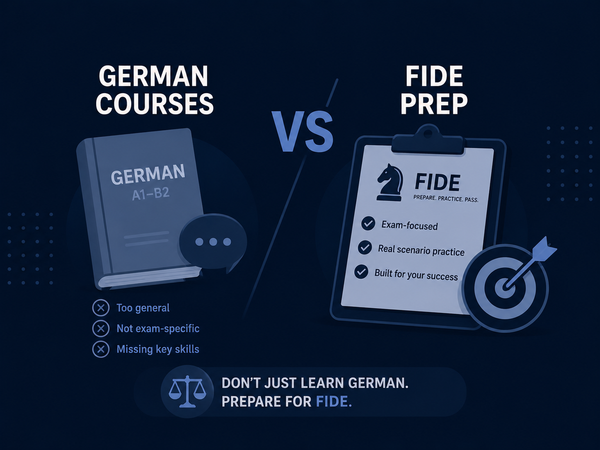
- German courses vs FIDE prep — when generic German doesn't cut it
- The FIDE picture description formula
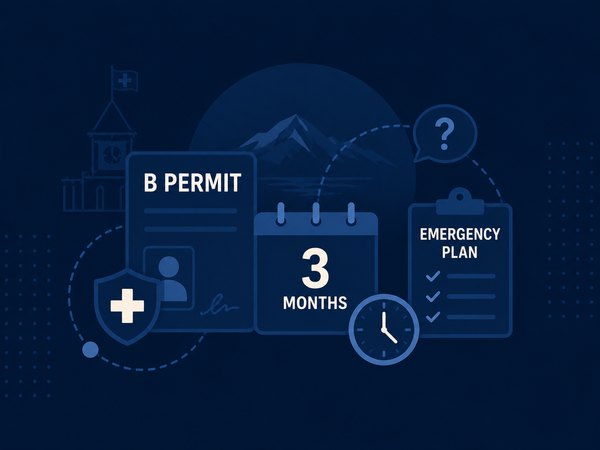
- B-permit emergency plan when your deadline is in 6 weeks
Next step
If "I'm not a language person" has been the voice in your head, the antidote isn't more affirmations — it's a small, finished thing you actually did. The book FIDE German A1/A2 Exam Prep walks through the 11 FIDE topics with structured vocabulary, dialogue scripts, and a 90-day plan you can tick off. Available as PDF on fide-prep.ch or as Kindle on Amazon.
Or sign up to the Sunday list and we'll send you the first chapter as a free PDF — small, finished, on your screen in two minutes. Get the free chapter →