FIDE Topics: The 11 Official Modules With Examples
All 11 FIDE speaking topic areas with example questions, phone-call scenarios, and the vocabulary you need — from Wohnumgebung to Behörden. Plus exactly how the speaking test is scored.
Quick summary
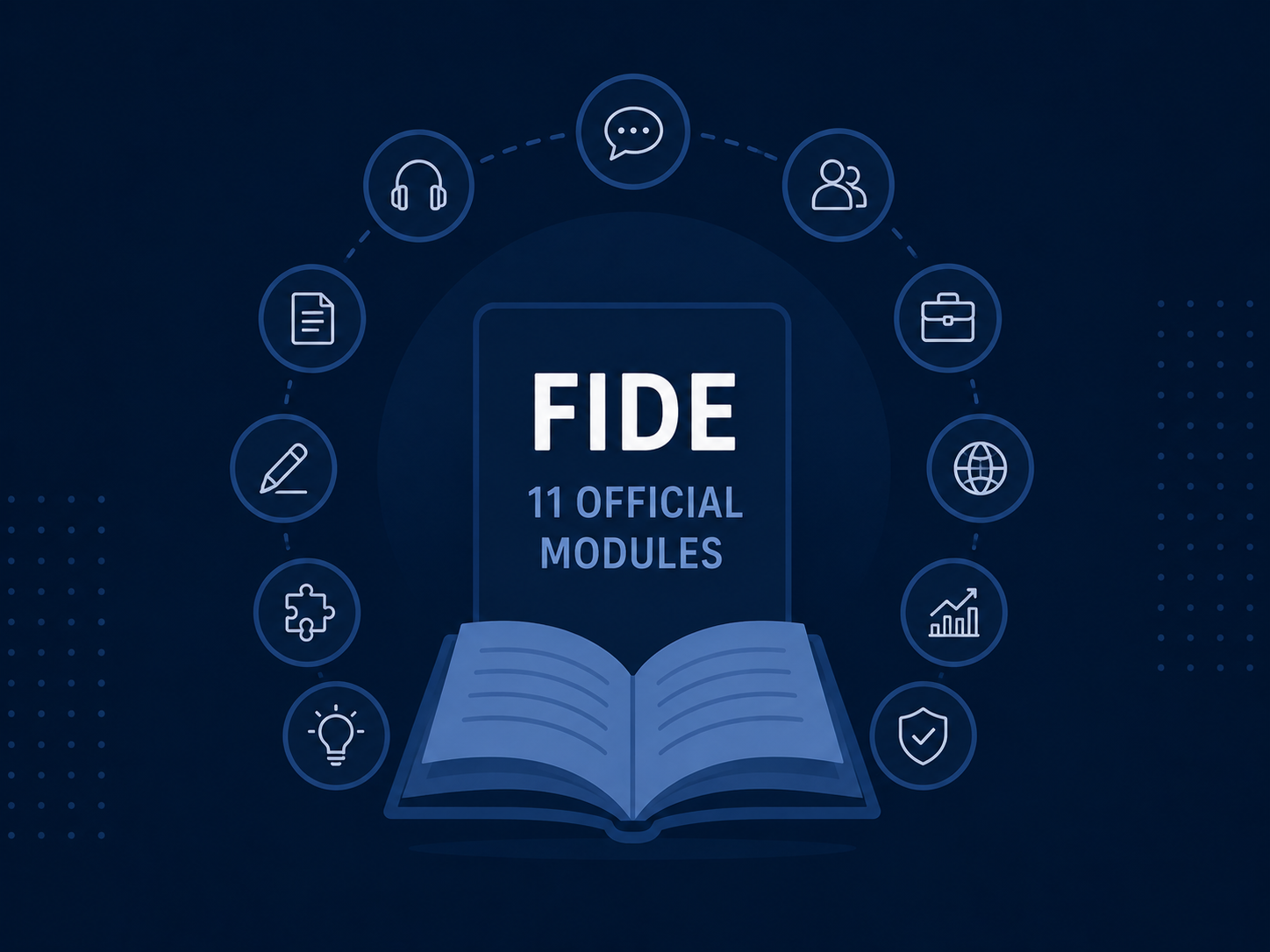
The FIDE speaking test covers 11 official topic areas based on everyday life in Switzerland. The test lasts about 15 minutes and consists of three tasks at A2 level: describing a picture, role-playing a phone call, and having a conversation. After these tasks, examiners direct you to either A1 or B1 level for additional tasks. You don't choose your level in advance — the test determines it based on your performance. The speaking part counts for two-thirds of your oral result. Preparation should focus on practising these 11 specific scenarios rather than studying general German.
New here? Start with the complete FIDE exam guide.
Of everything about the FIDE exam, the speaking part creates the most anxiety. I've seen it with my husband, with friends, and with dozens of people who've reached out since I started writing about FIDE preparation. The pattern is always the same: people feel relatively okay about reading and writing, but the idea of sitting in front of an examiner and speaking German makes them freeze.
Here's the thing — once you know exactly what the speaking test looks like and which topics it covers, most of that anxiety disappears. The FIDE speaking test is predictable. It follows a clear structure, always draws from the same 11 topic areas, and the examiners are not trying to trick you. They want to see you can communicate in everyday Swiss situations. That's it.
This guide breaks down every topic the FIDE speaking test draws from, explains exactly how the test works, and gives you practical examples so you know what to expect.
How the FIDE speaking test works
The speaking test lasts about 15 minutes. You sit across from one examiner who talks with you. A second examiner sits to the side, listens, and takes notes. There's no computer, no recording, no headphones — just a face-to-face conversation.
The test always starts at A2 level with three tasks:
Task 1 — Situationsbeschreibung (picture description). You receive a picture showing an everyday situation in Switzerland. You describe what you see — who's in it, where they are, what they're doing. The task is designed to show you can identify and talk about common situations. There's a 4-step formula that takes the panic out of this task.
Task 2 — Telefonat (phone call simulation). You role-play a telephone call with the examiner. You might need to make an appointment, change a reservation, cancel something, or ask for information. You give and receive information, react to what the examiner says, and handle a simple back-and-forth.
Task 3 — Gespräch (conversation). The examiner asks about your habits, preferences, experiences, or routines. The most open-ended part — but it still draws from the 11 official topics.
After these three A2 tasks, the examiners assess your performance and recommend either A1 or B1 for the next phase. They tell you their recommendation and you decide whether to accept. You confirm your choice with a signature.
If directed to A1: two shorter tasks — naming things you see in pictures, and responding to simple everyday interactions.
If directed to B1: a longer conversation where you describe an experience in detail, explain a process, discuss pros and cons of a situation, or give your opinion on a hypothetical scenario. The examiner gives you two topics to choose from.
Important scoring detail: the speaking part counts for two-thirds of your combined oral result. The listening comprehension part (Verstehen) makes up the remaining third. So your speaking is the single most important factor in your oral score.
For the A1–A2 test, you need a combined score of at least 26% for A1 and 65% for A2. For the A2–B1 test, you need at least 43% for A2 and 79% for B1.
The 11 official FIDE speaking topics
Every FIDE speaking task draws from one of these 11 topic areas. Each is based on real situations you encounter living in Switzerland. Each topic links to articles tagged with that area:
1. Wohnumgebung (Living Environment / Housing)
Everything related to where you live — your apartment, your landlord, your neighbours, your neighbourhood.
Examiner might ask: Where do you live? What does your apartment look like? Do you like your neighbourhood? Have you ever had a problem with your apartment? How do you communicate with your neighbours?
Phone call you might role-play: calling your landlord because the heating is broken; calling a Hausverwaltung to report a problem; calling a neighbour to discuss noise.
Picture you might describe: someone looking at an apartment listing; a neighbour talking to another neighbour; a person reading a letter from their Verwaltung.
Key vocabulary: die Wohnung (apartment), der Vermieter (landlord), die Miete (rent), der Mietvertrag (rental contract), die Nebenkosten (utilities), die Nachbarn (neighbours), die Heizung (heating), der Schlüssel (key), die Hausverwaltung (property management), umziehen (to move), kündigen (to give notice).
2. Medien und Freizeit (Media and Leisure)
How you spend your free time, media you consume, social plans.
Examiner might ask: What do you do in your free time? Do you read newspapers or watch TV? What did you do last weekend? Do you have any hobbies?
Phone call: calling a library about membership; calling a friend to make plans; reserving tickets for an event.
Key vocabulary: die Freizeit (free time), das Hobby, die Bibliothek (library), der Ausweis (membership card), ausleihen (to borrow), das Fernsehen (TV), die Zeitung (newspaper), das Abonnement (subscription), einladen (to invite), sich treffen (to meet up).
3. Verkehr (Transport)
Getting around in Switzerland — trains, buses, trams, cars, cycling.
Examiner might ask: How do you get to work? Do you use public transport? Have you ever had a problem with a train or bus? How is public transport where you live?
Phone call: calling SBB about a connection; reporting a lost item on public transport; calling a taxi.
Key vocabulary: der Zug (train), der Bus, das Tram, das Velo (bicycle, Swiss term), das Billett (ticket, Swiss term), das Halbtax, das GA, der Fahrplan (timetable), umsteigen (to change), die Verspätung (delay), die Haltestelle (stop).
4. Einkäufe (Shopping)
Buying things, returning things, dealing with shops and services.
Examiner might ask: Where do you shop? Have you ever returned something? How do you decide what to buy? Have you had a problem with something you bought?
Phone call: calling about a defective product; asking opening hours; checking availability.
Key vocabulary: einkaufen (to shop), das Geschäft (shop), die Quittung (receipt), umtauschen (to exchange), zurückgeben (to return), reklamieren (to complain), das Angebot (offer), der Preis, die Garantie, die Grösse (size — note Swiss ss).
5. Post, Bank und Versicherungen (Post Office, Bank, Insurance)
Financial and postal services in Swiss daily life.
Examiner might ask: Do you have a Swiss bank account? Have you sent a package at the post office? What kind of insurance do you have? Have you made an insurance claim?
Phone call: calling the bank about an account problem; tracking a package; calling your Krankenkasse about a bill.
Key vocabulary: das Konto (account), die Überweisung (transfer), das Paket (package), die Briefmarke (stamp), einzahlen (deposit), abheben (withdraw), die Krankenkasse, die Prämie (premium), die Rechnung (bill), die Franchise (deductible).
6. Gesundheit (Health)
Doctor visits, pharmacy interactions, health emergencies, the Swiss healthcare system.
Examiner might ask: How often do you go to the doctor? Can you describe a time you were sick? What do you do when you have a headache? Do you have a Hausarzt?
Phone call: making or changing an appointment; asking the pharmacy about medication; calling in sick to work.
Key vocabulary: der Arzt / die Ärztin (doctor), der Hausarzt (family doctor), die Praxis, der Termin (appointment), das Rezept (prescription), die Apotheke (pharmacy), Schmerzen haben (to have pain), Fieber haben (to have a fever), die Krankenkassenkarte, die Notaufnahme (emergency room).
One of the most commonly tested topics. Practise describing symptoms in simple German — you don't need medical terminology, just phrases like "Ich habe Kopfschmerzen" or "Mein Rücken tut weh."
7. Arbeit (Work)
Workplace situations, interactions with colleagues, work routines.
Examiner might ask: What is your job? What does a typical workday look like? Do you like your work? Have you had a problem at work? How do you communicate with colleagues?
Phone call: calling your boss to say you'll be late; requesting vacation time; calling a colleague about a meeting.
Key vocabulary: die Arbeit, der Beruf (profession), der Arbeitsvertrag, die Ferien (vacation, Swiss term — not Urlaub), der Chef / die Chefin, die Sitzung (meeting), Teilzeit, Vollzeit, das Gehalt (salary), kündigen.
8. Kinder (Children and School)
Childcare, school life, parent-teacher interactions, raising children in Switzerland. Even if you don't have children, this topic can come up.
Examiner might ask: Do you have children? Where do they go to school? What is a typical school day like? Have you been to an Elternabend? How did you find a daycare?
Phone call: reporting your child's absence; asking a Krippe about availability; arranging a parent-teacher meeting.
Key vocabulary: das Kind, die Schule, der Kindergarten (mandatory from age 4 in most Swiss cantons), die Krippe / die Kita (daycare), die Spielgruppe, der Elternabend, das Elterngespräch, die Hausaufgabe, das Zeugnis, die Lehrerin, sich krankmelden (report sick).
Swiss cultural note: in Switzerland, Kindergarten is part of the public school system and is mandatory and free in most cantons from age 4. Schools expect high parental involvement, and you'll receive many letters that require a written response.
9. Arbeitssuche (Job Search)
Looking for work, dealing with the employment office, and job interviews.
Examiner might ask: Have you looked for a job in Switzerland? What is your profession? How do you look for jobs? Have you been to the RAV?
Phone call: calling about a job advertisement; making an appointment with the RAV; following up on an application.
Key vocabulary: die Stelle (job), die Bewerbung (application), der Lebenslauf (CV), das Vorstellungsgespräch (job interview), das RAV (regional employment office), sich bewerben, die Stellenanzeige, die Erfahrung, die Ausbildung.
10. Weiterbildung (Further Education)
Courses, professional development, learning opportunities.
Examiner might ask: Have you taken a course in Switzerland? What would you like to learn? How do you learn best? Have you done professional training?
Phone call: registering for a course; asking about schedules and prices; cancelling a registration.
Key vocabulary: der Kurs, die Anmeldung, sich anmelden, die Prüfung (exam), das Zertifikat, die Kursgebühr (course fee), der Stundenplan, absagen (to cancel), die Volkshochschule, die Klubschule Migros (Migros adult education — very Swiss).
11. Behörden (Authorities)
Dealing with Swiss government offices — your Gemeinde, the migration office, the Strassenverkehrsamt.
Examiner might ask: Have you been to your Gemeinde? What did you need to do there? How did you get your residence permit? Have you had to fill out official forms?
Phone call: making an appointment at the Gemeinde; calling the migration office about your permit status; converting your driving licence at the Strassenverkehrsamt.
Key vocabulary: die Gemeinde, das Einwohneramt (residents' registration office), die Aufenthaltsbewilligung (B permit), die Niederlassungsbewilligung (C permit), die Einbürgerung, der Ausweis, das Formular (form), der Antrag (application), sich anmelden, sich abmelden, der Termin.
Especially relevant because the FIDE test was specifically designed for immigration contexts. Being able to discuss your interactions with Swiss authorities shows exactly the practical communication the test measures.
How to prepare for FIDE speaking
Knowing the topics is half the battle. How to turn that knowledge into exam readiness:
Practise describing pictures out loud every day. Find any picture of an everyday scene — on your phone, in a magazine, online — and spend 2 minutes describing it in German. Use simple sentences: "Ich sehe eine Frau. Sie ist in einer Apotheke. Sie spricht mit dem Apotheker." Daily for two weeks and it will feel completely natural on exam day. Use the 4-step formula.
Role-play phone calls. Get a language partner, a tutor on italki, or use an AI chatbot. Practise the most common scenarios: making an appointment, cancelling something, asking for information, reporting a problem. These calls follow predictable patterns; once you've done each type 5–10 times, you'll handle them with confidence.
Prepare a strong personal introduction. Every speaking test begins with small talk. Know how to say where you live, what you do for work, how long you've been in Switzerland, your family situation. Practise it until it flows naturally — sets the tone for the whole exam.
Learn time-buying phrases. Lifesavers when you need a moment to think: "Moment bitte…", "Können Sie das bitte wiederholen?" (Can you repeat that?), "Wie sagt man… auf Deutsch?" (How do you say… in German?), "Ich verstehe die Frage nicht ganz" (I don't fully understand the question). Using these is not weakness — it shows communicative competence, which is exactly what examiners want to see.
Listen to German every single day. Sounds like it's about listening, not speaking, but your brain cannot produce language patterns it has never heard. Listen to Easy German on YouTube, Langsam Gesprochene Nachrichten from Deutsche Welle, or the SRF news app. Even 15 minutes during your commute trains your ear. More on how to spend your prep time.
Don't memorise scripts. Examiners can tell immediately when someone is reciting a memorised answer, and it backfires the moment they ask a follow-up you didn't prepare for. Practise talking about each topic freely in your own words. Imperfect but genuine communication scores higher than perfect but robotic recitation.
What the examiners are actually looking for
FIDE speaking is not looking for perfect grammar. It's looking for:
- Can you make yourself understood? If the examiner can follow what you're saying, you're doing well — even if grammar is imperfect.
- Can you react to what the other person says? The phone call and conversation tasks test interaction, not monologues.
- Can you handle common everyday situations? The topics are practical for a reason — the test measures whether you can function in Swiss daily life.
- Can you use basic vocabulary for the topic at hand? You don't need advanced words; simple, correct vocabulary is enough.
"Ich sehe Mann. Er ist Arzt. Frau sitzt. Sie hat Problem mit Bein." is imperfect German but communicates clearly and would score points at A2. Don't let fear of mistakes stop you from speaking.
Frequently asked questions
Can I choose which topic comes up?
No. The examiner chooses the picture, the phone-call scenario, and the conversation topic. But all of them come from the 11 official topics, so if you've practised all 11, nothing will surprise you. At B1 you do get to choose between two conversation topics.
What if I don't have children — do I still need the Kinder topic?
Yes. The topic might come up as a picture description or a conversation question regardless of your personal situation. You might be asked to describe a school scene, or what schools are like in your home country.
What if I don't understand a question?
Ask the examiner to repeat it. "Können Sie das bitte wiederholen?" is perfectly acceptable. The examiner may rephrase to help you. Asking for clarification is a communicative skill the test values, not a penalty.
Should I try B1 when the examiner offers it?
Only if you specifically prepared for B1. B1 tasks require describing experiences in detail, explaining processes, and discussing pros and cons — a significant step up from A2. If you prepared for A2, take the safe A1 route and lock in a solid A2 result.
Are all 11 topics tested in every exam?
No. Each candidate gets one picture (one topic), one phone-call (often a different topic), and one conversation (usually a third topic). Across one exam you'll typically encounter 2–3 of the 11. But you don't know in advance which, so prep all 11.
Related reading
- The complete FIDE exam guide
- The FIDE picture description formula — speak confidently in 4 steps
- How long to prepare for FIDE — a realistic timeline
- B-permit emergency plan when your deadline is in 6 weeks
- FIDE vs Goethe — which German exam should you take?
Start practising today
The fastest way to prepare for the FIDE speaking test is to practise with the actual topics and scenarios you'll encounter. The book FIDE German A1/A2 Exam Prep includes real dialogue scripts for all 11 topics, essential vocabulary lists, and practical speaking exercises designed around the exact FIDE test format. Available as PDF on fide-prep.ch or as Kindle on Amazon.
Or sign up to the Sunday list and we'll send you the first chapter as a free PDF. Get the free chapter →